AC Repair & Installation in Bucks County
Pennsylvania summers are no joke, and they're humid, which is the part most people underestimate. Whether your system stopped cooling this morning or it's been struggling all season, we handle repair, replacement, and seasonal tune-ups on every major brand. Same-day service on most calls.
The AC Problems We See Most Around Here
Bucks County housing stock is unusually varied: 1950s Levittown builds, 1980s colonials, and recent developments within a few miles of each other. Each one fails in its own way.
Humidity, not just heat
Pennsylvania summers are humid, and an oversized system makes it worse. It cools fast, shuts off before pulling moisture out, and leaves the house cold and clammy.
Older homes, newer expectations
Much of the local housing stock predates central air. Retrofitted ductwork is often undersized or leaky, which caps what any system can deliver. Sometimes the fix is the ducts, not the unit.
Sized for a different house
Additions, finished basements, and converted garages change the load. A system that suited the house in 1998 may be badly matched to it now.
What That Looks Like in Your House
Most systems warn you before they quit. These are the symptoms worth a call today rather than next week.
Running but not cooling
Ice on the unit or lines
Turning on and off constantly
New grinding or squealing noises
Any of these are worth diagnosing early. A system straining to cool puts load on the compressor, which is the expensive part to replace. If the house is genuinely unbearable, say so when you call and it goes to the front of the queue.
AC Repair Across Bucks County
Pennsylvania summers are no joke, and a system that quits in July isn't something that waits until next week. We run same-day repair seven days a week, and our technicians carry common failure parts on the truck: capacitors, contactors, motors. That means a good share of calls are diagnosed and fixed on that first visit rather than waiting on an order.
Diagnosis comes before a quote. We'd rather find out whether it's a fifty-dollar capacitor or a failing compressor than guess from the driveway, and you get the number before any work starts.
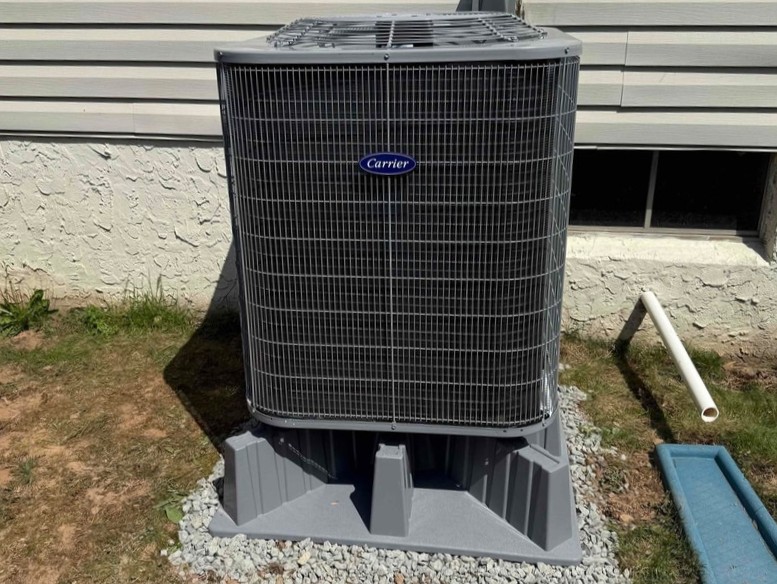
We service every major brand: Carrier, Trane, Goodman, Rheem and others. That matters more than it sounds. We're not contracted to one manufacturer, so what we recommend comes from what your system actually needs rather than what we're obliged to sell.
What's Included
- Same-day AC repair, 7 days a week
- Free in-home replacement estimates
- All major brands: Carrier, Trane, Goodman, Rheem
- Systems up to 22 SEER
- Financing from $89/mo · $0 down
- Permits, install and haul-away handled
Replacing an Aging System
Most air conditioners run 12–15 years. Past that, repairs tend to become a pattern rather than a one-off, and once a repair costs more than about a third of a replacement, replacing usually works out cheaper across a few years.
When it is time, the install matters as much as the equipment. We size the system to the house rather than matching whatever was there before, which means measuring square footage, ceiling height, window orientation, insulation, and ductwork condition instead of reading the label off the old unit. Get that wrong and even a top-of-the-range system underperforms.
Permits and inspection coordination are handled, the old unit is hauled away, and most installations are finished in a single day. Every technician is NATE-certified and W-2, with no subcontracted crews.
What Determines Your Number
Any contractor quoting a firm price before seeing your house is guessing. Three things set it.
The size the house needs
Measured properly, not matched to the old unit.
The efficiency level
Higher SEER costs more up front and less to run. We'll tell you where the sensible stopping point is.
The scope of the work
A straight swap is simpler than a job needing ductwork or electrical changes. We flag that before we start.
What you get is one installed price: equipment, labor, permits, and standard materials in a single number. Not a low equipment quote with the real costs appearing later.
Free in-home evaluation, no obligation.
Your Old Unit Is Worth Something
Even a system that's barely limping along carries trade-in value toward a new one, up to $5,000 depending on what you're replacing and what you're replacing it with, confirmed during the evaluation. There's $0 down and financing from $89 a month for qualifying homeowners, subject to credit approval.
Getting More Out of the System You Have
Not every cooling problem needs a new system. A lot of what looks like a failing unit is one that's been running dirty for a few summers.
The outdoor coil is usually the culprit. It sheds heat, and when it's packed with grass clippings, cottonwood, and dust, it can't. The system then runs longer to reach the same temperature and the compressor works harder than it was designed to. Cleaning it is unglamorous and it's the single biggest thing that restores lost capacity.
The rest is catching parts that are wearing but haven't failed. A capacitor weakens before it dies, and it almost always dies on the hottest day of the year, because that's when the system is under the most load. Replacing a weak one in April is a routine part swap. Replacing it in a July heatwave means an emergency call, a full house, and often a compressor that's taken damage in the process.
The whole visit takes about an hour. Spring is the time: everyone calls at once the day it first hits ninety, and that's the week nobody has availability.
Coil cleaning and airflow check
Refrigerant level and leak check
Electrical connections and capacitor test
Thermostat calibration and cycle test
AC Questions We Get a Lot
Usually low refrigerant, a dirty or failing coil, or a compressor on its way out. The distinction matters because the first two are routine repairs and the third often isn't worth doing on an older system, which is why we diagnose before quoting.
Ice on the refrigerant lines or coil means airflow or refrigerant is wrong: a blocked filter, a failing blower, or low refrigerant. Turn the system off and let it thaw completely before anyone works on it; running it frozen can damage the compressor.
Short-cycling. Sometimes a thermostat or sensor fault, but often the system is oversized for the house. It cools the air fast, shuts off before removing any humidity, and starts again minutes later.
SEER measures how much cooling you get per unit of electricity across a season. Higher is better, but the gap matters most at the low end:
- 13–14: older systems and the legal minimum for years. Upgrading from here gives the biggest improvement.
- 15–16: the common middle ground today. Meaningfully more efficient without a premium price.
- 17–19: high efficiency. Worth it if you run cooling hard or plan to stay in the house.
- 20+: top tier, usually variable-speed. Best humidity control, quietest, highest up-front cost.
Most homes land well at 15–16.
Yes, through third-party lenders and subject to credit approval. Approval usually comes back within minutes of applying. Current offers are on our special offers page.
Let's Get the House Cool Again
Free estimate, no obligation. Tell us what your system is doing and we'll tell you honestly whether it needs a repair or a replacement.